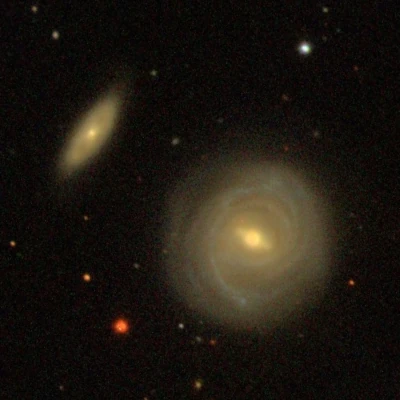
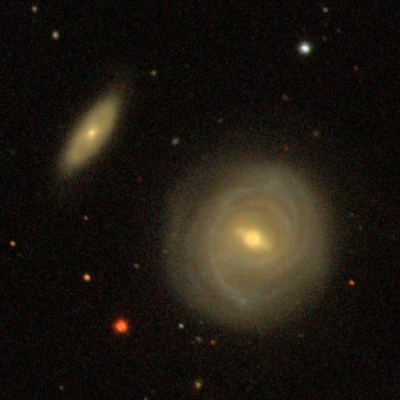
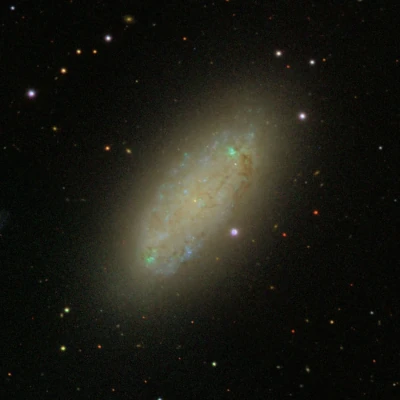
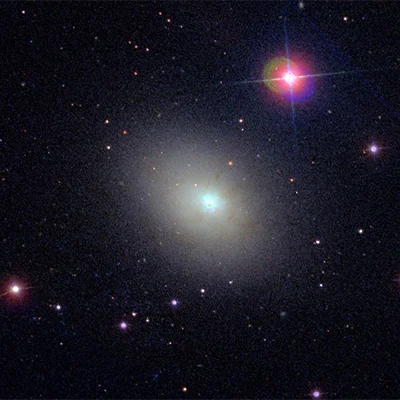
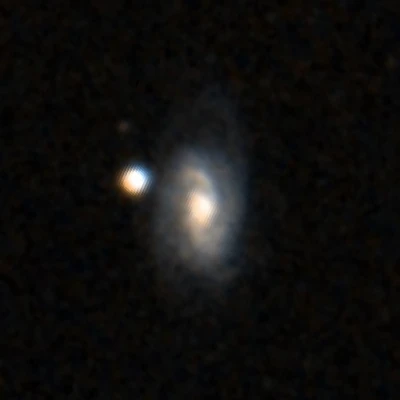
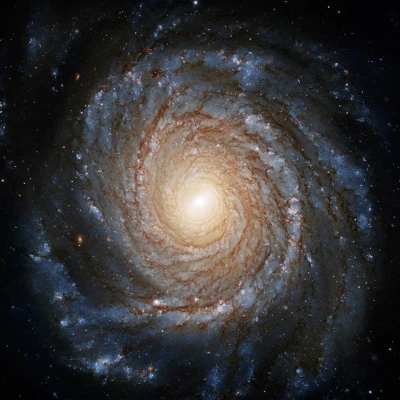
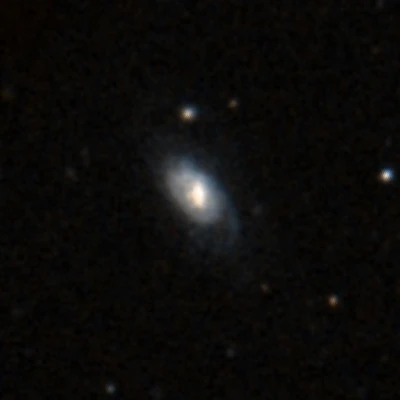
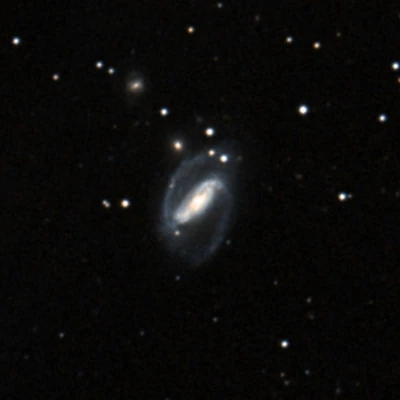
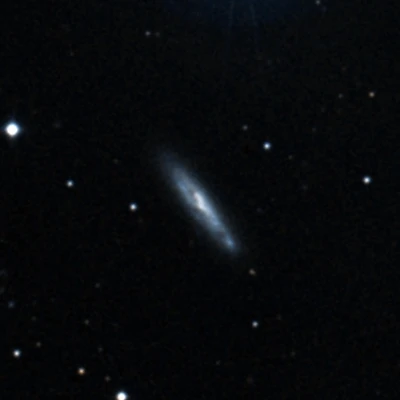
Galaxy NGC 2985
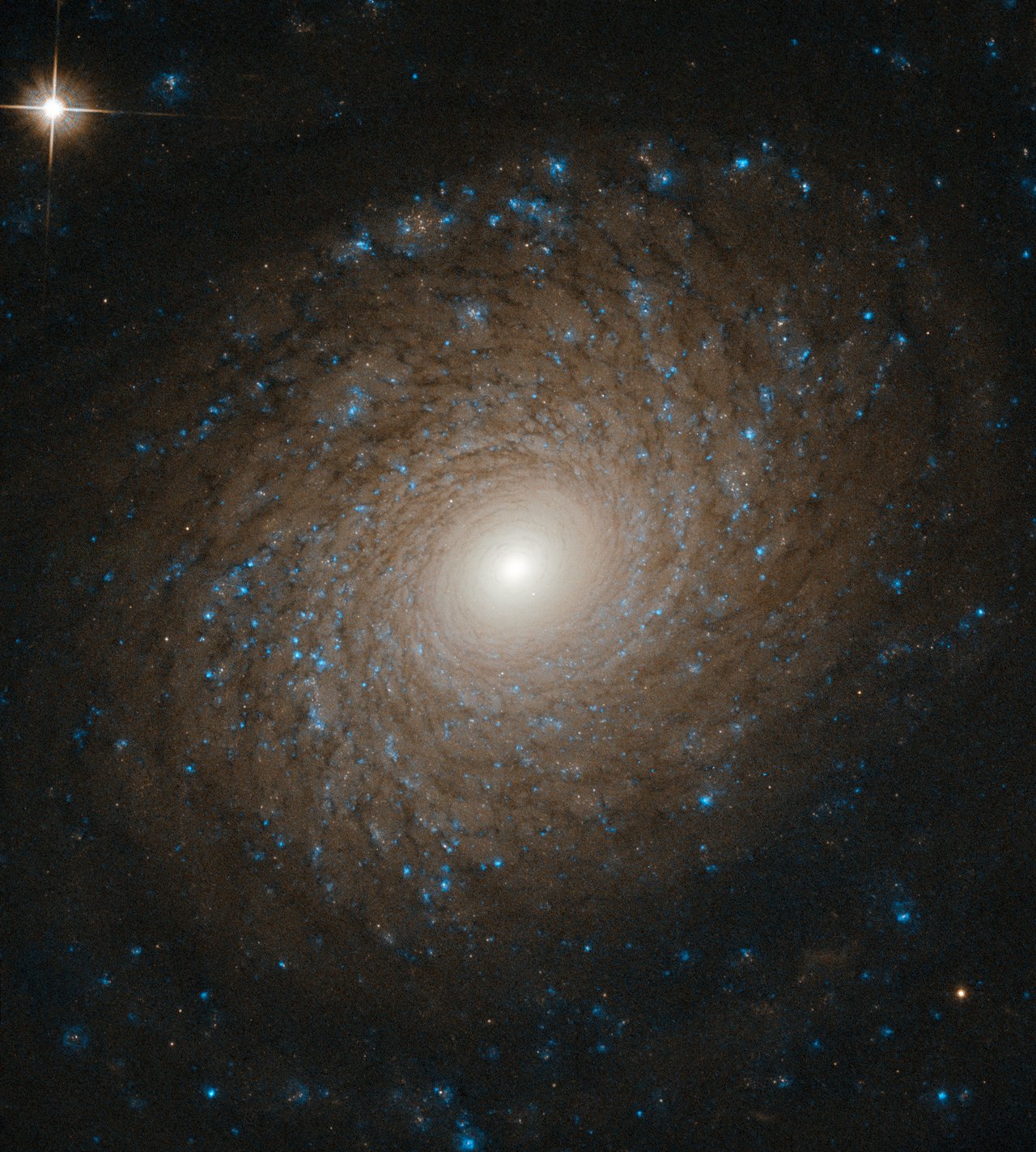
Galaxy NGC 2985
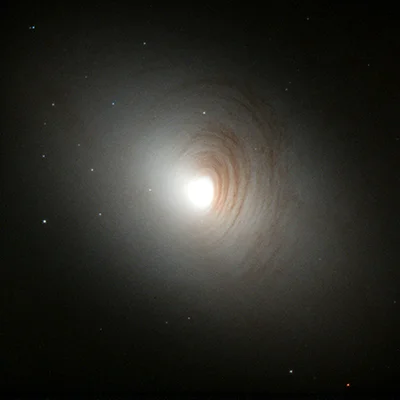
The galaxy NGC 2985 was discovered by William Herschel on 3 April 1785 using his 18.3-inch reflecting telescope. He listed it as «bright nebula» I 78 and noted: «Very bright, considerably large, much brighter middle.» [463]
| Designation | NGC 2985 |
| Type | Gx (Sb) |
| Right Ascension (J2000.0) | 09h 50m 21.4s |
| Declination (J2000.0) | +72° 16' 43" |
| Diameter | 4.6 × 3.4 arcmin |
| Photographic (blue) magnitude | 11.2 mag |
| Visual magnitude | 10.4 mag |
| Surface brightness | 13.3 mag·arcmin-2 |
| Redshift (z) | 0.004410 |
| Distance derived from z | 18.63 Mpc |
| Metric Distance | 21.500 Mpc |
| Dreyer Description | vB, cL, R, psmbM, * inv f |
| Identification, Remarks | WH I 78; h 629; GC 1909; UGC 5253; MCG 12-10-6; CGCG 333-4; CGCG 332-67; IRAS 09459+7230 |
Nearby Galaxies
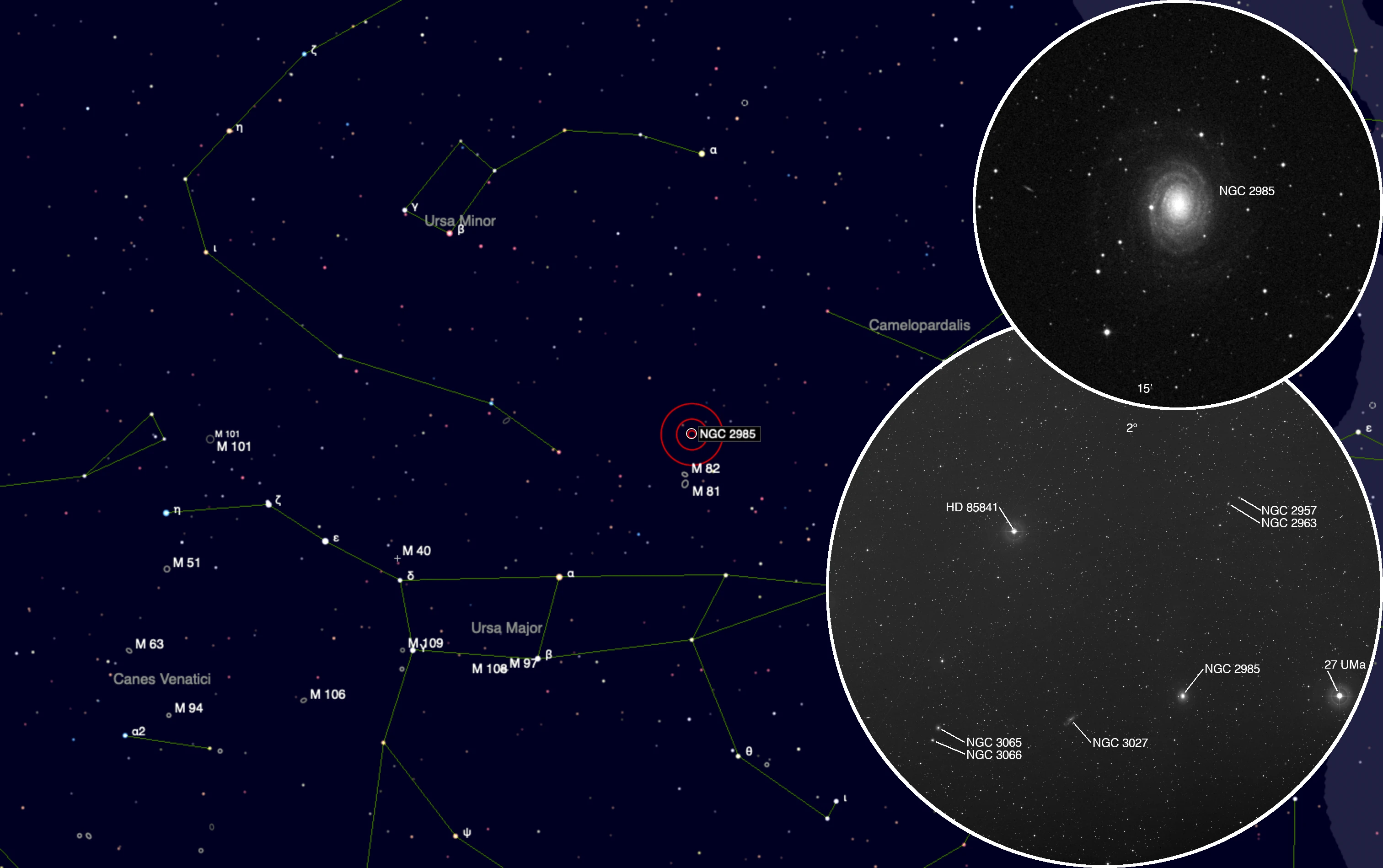
Also in the same night on 3 April 1785 William Herschel discovered these fainter galaxies in the vicinity: NGC 2963 (very faint nebula, III 315), NGC 3027 (very large nebula, V 23), NGC 3065 (faint nebula, II 333) and NGC 3066 (faint nebula, II 334). [463]
John Herschel discovered the galaxy NGC 2957 (h 617) on 4 November 1831 (sweep 382), which had been overseen by his father. He recorded: «Extremely faint, has a star 13mag near.» [466]
| Name | RA | Dec | Type | bMag | vMag | B-V | SB | Dim | PA | z | D(z) | MD | Dreyer Description | Identification, Remarks |
|---|---|---|---|---|---|---|---|---|---|---|---|---|---|---|
| NGC 2957 A | 09 47 15.3 | +72 59 12 | Gx (E1) | 15.8 | 14.8 | 1.0 | 11.8 | 0.3 × 0.2 | 12 | 0.022999 | 97.15 | eF, * 13 nr | h 617; GC 1892; MCG 12-10-1; MK 121; NPM1G +73.0057 | |
| NGC 2957 B | 09 47 17.9 | +72 59 02 | Gx (E6) | 15.7 | 14.7 | 1.0 | 13.1 | 0.7 × 0.3 | 42 | 0.022856 | 96.54 | eF, * 13 nr | h 617; GC 1892; MCG 12-10-2; CGCG 332-64; CGCG 333-2 | |
| NGC 2963 | 09 47 49.8 | +72 57 52 | Gx (SBab) | 14.3 | 13.5 | 0.8 | 13.0 | 1.2 × 0.6 | 165 | 0.022899 | 96.72 | vF, vS, R, bM | WH III 315; h 619; GC 1895; UGC 5222; MCG 12-10-3; MK 122; IRAS 09431+7311; CGCG 333-3; CGCG 332-65 | |
| NGC 3027 | 09 55 40.3 | +72 12 15 | Gx (SBcd) | 12.2 | 11.8 | 0.4 | 14.0 | 3.9 × 1.4 | 130 | 0.003529 | 14.91 | 19.760 | vF, vL, lE, r | WH V 23; h 643; GC 1947; UGC 5316; MCG 12-10-9; CGCG 332-68; IRAS 09513+7226; CGCG 333-6; VV 358; KUG 0951+724 |
| NGC 3065 | 10 01 55.1 | +72 10 12 | Gx (S0) | 13.5 | 12.5 | 1.0 | 13.5 | 1.7 × 1.5 | 21 | 0.006671 | 28.18 | 31.300 | pF, vS, R, bM, * 11 nr | WH II 333; h 654; GC 1969; UGC 5375; MCG 12-10-14; CGCG 333-10; 7ZW 303 |
| NGC 3066 | 10 02 10.0 | +72 07 32 | Gx (SBb/P) | 13.6 | 12.9 | 0.7 | 12.9 | 1.1 × 1 | 159 | 0.006835 | 28.87 | 32.400 | vF, vS, vglbM | WH II 334; h 655; GC 1971; UGC 5379; MCG 12-10-15; MK 133; IRAS 09578+7222; KUG 0957+723; Z 0957.9+7222; CGCG 333-11 |
Finder Chart
The galaxy NGC 2985 is located in the constellation Ursa Maior. On 15 February it is in opposition with the Sun and is therefore highest in the sky at local midnight.